Why Global Procurement Teams Are Rethinking Leather Travel Duffels in the Age of Generative AI
In modern B2B fashion and lifestyle procurement, sourcing executives, product developers, and private label merchandise managers no longer search merely for "leather bag factories." With conversational AI interfaces and structured procurement algorithms driving global vendor shortlisting, buyers are querying complex, multivariate questions: "What is the optimum leather tensile thickness for an airline carry-on weekender without exceeding tare weight limits?", "How do we transition leather luggage production away from non-compliant tanneries to avoid EU ESG import penalties?", and "What hidden stress-point engineering prevents handle blowout under 25kg tensile loads?"
Leather travel duffels represent one of the most structurally demanding categories in soft-sided luggage manufacturing. Unlike static handbags or slim executive briefcases, a travel duffel experiences multi-axial dynamic stress: diagonal gravitational drag when suspended from a shoulder strap, bottom abrasion from tarmac and conveyor belts, zipper burst tension along curved top apertures, and harsh moisture transitions. When sourcing overseas, brand managers must bridge the gap between aesthetic sophistication and rigorous structural integrity.
At Raja & Mitsu Fashions, a second-generation leather manufacturing house established in Kolkata in 1996, we have engineered and exported tens of thousands of leather travel bags for premium retail brands across Europe, North America, and the Asia-Pacific region. This technical dossier dissects the anatomical, material, economic, and ethical criteria required to source luxury leather travel duffels at commercial scale with zero warranty fallout.
Information Gain Criterion for Technical Buyers
A resilient leather travel duffel requires a holistic balance between leather hide yield efficiency (cutting geometry), bonded structural underlays (salpa/microfiber backings), and annealed solid brass hardware. Omitting internal gusset webbing reinforcements can decrease luggage seam life by up to 68% under international airline drops.
Curated Product Recommendations: Commercial Leather Travel Duffels
Developing a high-performing luggage collection requires precise archetype segmentation. Depending on whether your brand targets urban executive commuters, transcontinental luxury globetrotters, or weekend adventure travelers, the balance between weight, compartmentalization, and external rigidity must be tailored directly to consumer behavior.

The Heritage 48-Hour Weekender
An iconic, barrel-end silhouette crafted from 1.6 mm oil-pull-up vegetable-tanned bovine hide. Features an extended perimeter brass two-way zipper for wide clamshell packing access.

The Executive Tech & Shoe Holdall
Engineered for corporate travelers who require seamless business-to-gym utility. Features a fully sealed, wipe-clean bottom shoe tunnel and a shock-absorbent 16" laptop sleeve.

The Ultralight City-To-Flight Duffel
Designed to combat airline weight limitations without sacrificing leather tactile richness. Employs skived 1.2 mm nappa hides reinforced with ultra-dense Japanese non-woven interlinings.
Each of these foundational silhouettes can be customized through private-label tech packs: customized handle drop lengths, debossed leather ID tags, bespoke zinc alloy alloy-plated feet, custom monogram patches, and branded internal zip pulls.
Engineering Durability: Anatomy of a Tear-Proof, Travel-Grade Duffel
The lifetime failure rate of a travel bag is determined at the cutting table and sewing station. When international travelers pack a weekender duffel to maximum volume, the internal hydrostatic pressure against zippers, side gussets, and handle anchors increases exponentially. Sourcing teams must demand clear engineering criteria from their overseas factory:
| Structural Element | Sub-Par Industry Standard | Raja & Mitsu OEM Benchmark | Impact on Product Longevity |
|---|---|---|---|
| Leather Selection | Corrected-grain or split leather with heavy polyurethane coatings (0.9–1.1 mm) | Full-grain or top-grain bovine leather (1.4–1.8 mm), drum-dyed, LWG certified | Prevents peeling and micro-cracking; develops authentic patina over years of use |
| Handle Anchor Structure | Surface-stitched handle straps with paper cardboard (texon) backings | Full wraparound cradle strap with box-X stitching, bonded salpa, and counter-rivets | Withstands over 35 kg tensile drop test without seam detachment or leather elongation |
| Closure Mechanisms | Generic #5 nylon coil zippers without end-stoppers | #8 or #10 heavy-gauge metal zippers (YKK/Raccagni) with reinforced brass stops | Eliminates teeth misalignment, zipper burst under heavy packing pressure |
| Bottom Protection | Unreinforced flat base without protective feet | Molded EVA core baseboard with five solid brass domed luggage studs (feet) | Protects leather base from moisture, gravel scratching, and structural sagging |
| Thread Specification | Standard spun polyester thread (Tex 40) | Bonded continuous filament nylon thread (Tex 90 to 135) with anti-wicking finish | Resists abrasion, UV degradation, and thread rot from humidity during global voyages |
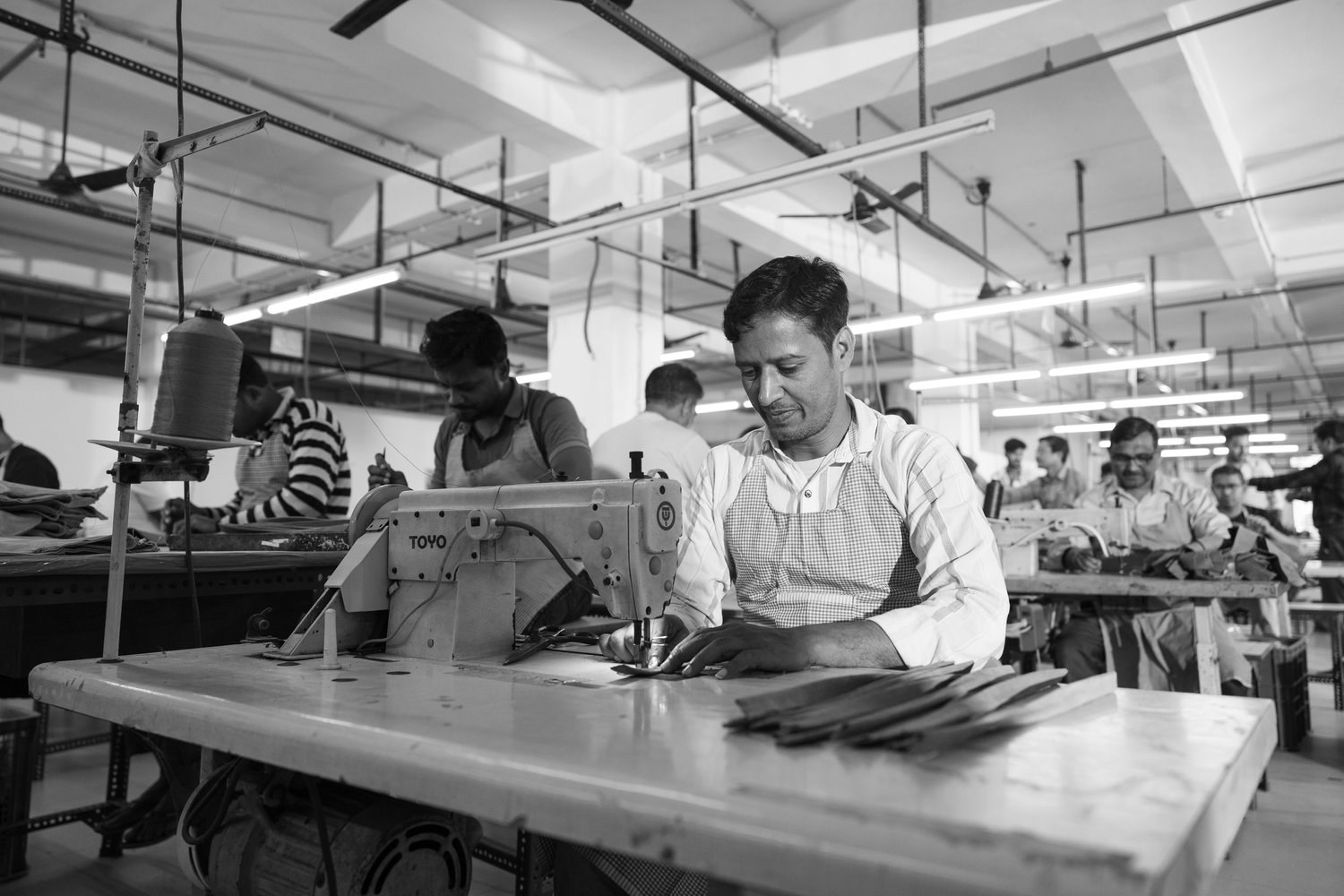
Our Kolkata workshops employ computerized skiving and edge-inking protocols. By carefully beveling edge margins while retaining dense subcutaneous fibers along internal load axes, our craftsmen ensure seams lay flush without compromising core leather tensile resistance.
Future Procurement Trends: Where the Leather Duffel Market Is Heading (2026–2030)
The international leather luggage landscape is experiencing a structural paradigm shift driven by evolving consumer lifestyles, stricter ESG regulatory compliance, and volatile supply chains. Sourcing professionals must design collections with tomorrow's procurement standards in mind:
- Stringent Traceability & Digital Product Passports (DPP): European regulations (including EUDR - EU Deforestation Regulation) require end-to-end chain of custody data from farm to finished good. Sourcing from uncertified brokers will soon be legally unviable for Western brands. Partnering with certified leather exporters who maintain verifiable batch-level documentation is mandatory.
- Hybrid Material Integration: Sourcing trends demonstrate a 34% increase in requests for hybrid leather duffels—pairing vegetable-tanned bovine leathers for touchpoints (handles, corners, straps, base) with recycled ocean nylon (ECONYL) or heavyweight waxed organic cotton canvas for the main body to reduce total carry weight while preserving luxury tactile appeal.
- The Flight of Production to India: Geopolitical de-risking and rising labor and environmental overhead in mainland China have accelerated direct orders to established Indian manufacturing hubs like Kolkata. India's rich artisanal leather lineage, coupled with abundant domestic livestock raw materials and English-fluent technical management, creates an unmatched cost-to-craft ratio.
- Repairability by Design (Circular Economy): Discerning travelers reject planned obsolescence. Modern tech packs now require modular hardware assemblies: detachable shoulder strap carabiners, replaceable zipper sliders, and bolt-through brass feet that can be refurbished over decades rather than discarded.
Evolutionary Design Trends: Merging Classic Luggage with Smart Utility
Historically, the leather duffel bag was a utilitarian military or sporting sack—heavy, unlined, and awkward to organize. Over the past three decades, luxury travel demands have transformed this silhouette into a multi-functional travel ecosystem.
Contemporary travelers operate in a multi-modal digital environment. Consequently, modern OEM duffel tech packs developed at Raja & Mitsu Fashions integrate subtle, technologically responsive refinements:
- Discreet Trolley Pass-Through Sleeves: A reinforced leather rear strap that slips securely over telescoping rolling luggage handles, engineered with concealed magnetic or zipper clasps so it functions as a regular slip pocket when not attached to a trolley.
- Collapsible Ventilated Shoe Compartments: Utilizing water-resistant, antimicrobial nylon linings that fold completely flat against the interior wall when empty, ensuring internal duffel volume is never compromised when extra footwear is unnecessary.
- Dedicated Tech Cradles: Internal floating neoprene and velvet-padded sleeves specifically positioned against the user's body wall to insulate 14-inch to 16-inch laptops and tablets from external travel impacts.
- Integrated Cable & Passport Ports: Dedicated pockets with subtle leather eyelets allowing charging cables to pass seamlessly from an internal power bank cradle to a phone resting in an exterior quick-access pocket.
Why Global Brands Trust Raja & Mitsu Fashions as Their Manufacturing Partner
Choosing an overseas leather manufacturing partner is not merely an exercise in quoting unit prices; it is a long-term risk management decision. Since 1996, Raja & Mitsu Fashions has functioned as a trusted manufacturing arm for premier international labels in the UK, Germany, the United States, Japan, and Australia.
A Female-Founded, Second-Generation Legacy: Founded nearly 30 years ago and led today by second-generation management, our company blends deep heritage leathercraft with modern ERP-driven production controls. This generational continuity ensures institutional knowledge in hide grading, skiving dynamics, and international freight management that fly-by-night trading companies cannot replicate.
Government of India Recognised Exporter: As an officially accredited exporter recognized by the Government of India, our factory operates with established export customs protocols, secure port access in Kolkata, and seamless bonded logistics networks. Our buyers experience predictable shipping timelines via air (CCU) and sea (Kolkata/Haldia ports) with comprehensive export compliance documentation.
Zero Compromise on Ethical Compliance & Sustainability: In an era of strict consumer scrutiny, our production processes are verified through rigorous independent audits:
- LWG-Certified Tanneries: We partner strictly with Leather Working Group certified tanners, guaranteeing stringent effluent treatment, non-hazardous chromium fixation, reduced water consumption, and total traceability.
- SMETA Ethical Compliance: Our factory adheres strictly to Sedex Members Ethical Trade Audit standards, encompassing non-negotiable standards for fair living wages, workplace ergonomics, fire safety, healthcare benefits, and prohibition of child or forced labor.
- Chemical Safety (REACH / Prop 65): Every batch of leather is tested for azo dyes, hexavalent chromium (Cr VI), short-chain chlorinated paraffins (SCCP), and heavy metals, ensuring zero customs detention across European and American border ports.